
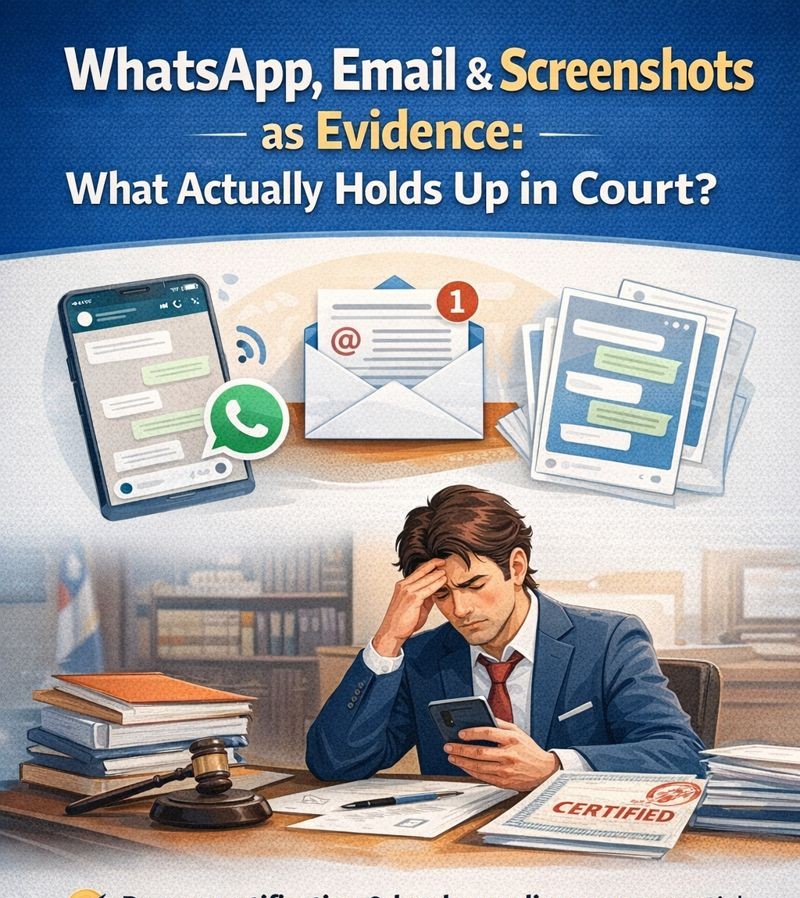
WhatsApp, Email & Screenshots as Evidence: What Actually Holds Up in Court? Your Heading Text Here
In an age where most conversations happen digitally, WhatsApp messages, emails, and screenshots often become the centre of legal disputes. Businesses, startups, and individuals frequently ask whether such digital communications are valid evidence in court. The reality is that courts do accept electronic communication as evidence, but not in the casual way most people assume. What matters is not just the content of the message, but how it is presented and proven.
WhatsApp chats are commonly relied upon in commercial disputes, employment matters, and contractual disagreements. While courts do recognize WhatsApp messages as electronic evidence, they do not automatically accept screenshots or printed chats at face value. Courts are cautious because digital messages can be altered, deleted, or taken out of context. To be considered reliable, the messages must be shown to be genuine, untampered, and sourced directly from the original device. Without proper verification, even truthful conversations may be questioned.
Screenshots are one of the weakest forms of digital evidence when used alone. Since screenshots can be edited easily, courts often treat them with suspicion. Many people believe that a screenshot is enough to prove their case, but in practice, screenshots require strong supporting proof. When screenshots are backed by proper certification and supported by other records such as emails, call logs, or consistent conduct between parties, they gain credibility. Without this support, screenshots may carry very little evidentiary value.
Emails are generally viewed as more reliable than instant messages, particularly in business and contractual disputes. Emails usually contain metadata, timestamps, and identifiable sender and recipient details, which makes authentication easier. However, this does not mean emails are automatically accepted by courts. Like all electronic records, emails must also be produced in a legally compliant manner. Improper extraction or presentation can weaken their impact, even if the content itself is genuine.
One of the most common reasons digital evidence fails in court is procedural negligence. People often delete original devices, forward chats multiple times, edit conversations, or submit partial records. These actions raise doubts about authenticity and create opportunities for the opposing party to challenge the evidence. Courts place significant importance on the integrity of electronic records, and any break in the chain of authenticity can reduce their reliability.
There is also a misconception that deleted WhatsApp messages can never be used in court. In certain cases, deleted data can be recovered through proper forensic methods and may still be admissible if legally authenticated. However, courts examine such evidence very closely, and even minor inconsistencies can lead to rejection. This makes early legal guidance and proper data preservation extremely important.
For businesses and individuals, the safest approach is to treat digital communication with the same seriousness as formal documentation. Preserving original devices, avoiding unnecessary edits, and seeking legal advice before relying on WhatsApp messages, emails, or screenshots can significantly improve the chances of success in court. Digital evidence is powerful, but only when handled correctly.
In modern litigation, WhatsApp messages, emails, and screenshots often play a decisive role. Courts do accept them as evidence, but only when legal standards are strictly followed. In disputes, it is not enough to have the conversation on your phone or inbox. What truly holds up in court is evidence that is authentic, legally compliant, and properly presented. Sound legal guidance ensures that digital communication becomes a strength rather than a weakness in any case.